Showing posts with label Book Worm. Show all posts

Friday, September 6, 2013

The Subtle Allusion to Jack London’s “To Build a Fire” in "One Direction: This Is Us"


Part of me feels like an uber nerd for making a Jack London reference for this, but then I remember that Morgan Spurlock directed One Direction: This Is Us and I feel OK with it. And, appropriately, from henceforth we will call the 1D movie “the film.” It legitimizes me. For myself.

As I watched the film with my esteemed colleagues sipping boxed Sauvignon Blanc and eating red vines, I was mesmerized by the whimsy of the carefree musical geniuses from the UK (can’t forget about Niall, that Irish fool). From Liam saying he wanted to be a fireman so he could save people to the lads singing “Let Me Be Your Last Kiss-Reggae Version” to Zayn’s Bob Marley board shorts, it was nothing short of amazing. I laughed. I sang along. I heckled. (#sauvignonblanc)

And then the snob cloud shrouded me.

The lads went camping, and Louis coyly stepped out as the other four tried to assemble their tents. (I am certain some poor camera crew member had to step in and assemble the tarp tipis for them in the end.) Then all five attempted to make a fire to warm their manly bristles called facial hair and illuminate their luscious locks in the night. But they were, as it were, unable to build a fire. 

So I leaned over to my fellow film-watcher and whispered, “It’s like Jack London’s ‘To Build A Fire!’” Allow me to explain.  In the short story, we meet “the man” who falls through ice on the Yukon Trail and needs to build a fire to warm himself. In the film, we meet our five international sensations and their perfectly gelled-manes as they decide to rough it in some backyard. In the story, we see “the man" build a fire, only to have it extinguished by the melting snow falling from the branches above. In the film, we see the British gents lean some logs together and assume they will stay up on their own, but alas no. So much mirroring! Until, of course, we get to the part in London’s story when the protagonist dies of hypothermia. Spoiler alert, 1D fans, Liam, Louis, Harry, Niall, and Zayn live through the film.

So, the parallel ends there. But it was fun while it lasted.

Wednesday, June 20, 2012

5 Spiritual Books & Poetry Anthologies by Women Writers

 
1. Absolute Trust in the Goodness of the Earth by Alice Walker
Walker’s poetry responds to post-9/11 emotional trauma with “less yang, far, far more yin.” Her poems imagine meditative spaces and explore native traditions of the Americas and Africa for spiritual healing in the West.
 2. Thirst by Mary Oliver
This anthology of poems, written after the death of Oliver’s life partner, has an elegiac tone as the poet encounters faith, healing, and restoration. Poems address grief, belief, and meditation, as exemplified in the poem, “Prayer.”
 3. The Stream and the Sapphire by Denise Levertov
Levertov’s collection of poems reclaims Biblical myths and figures from a feminist lens. Her poetry serves as a spiritual exercise that contemplate grace while inspiring Ignatian-like social justice.
 4. Aunt Carmen’s Book of Practical Saints by Pat Mora
Mora’s poetry acts as an extension of the rural New Mexican Catholic tradition of worshipping local saints. Her poetry-as-prayer is paired with images of wood-carved saints, aligning multiple art media with spiritual vocation.
 5. The Fifth Sacred Thing by Starhawk
Starhawk, a prominent pagan feminist who practices earth-based spirituality, explores ecological crisis, progressive love relationships, and spiritual odysseys in her famous post-apocalyptic novel.

Saturday, May 12, 2012

The Letter Project: The Genius of Penguin Cover Story Postcards


These lovely postcards with the covers of classic literature provide the unique opportunity to send both a message from you and the literary canon to family and friends.

Use to share with friends that this last month was the best of times, it was the worst of times. Or explain that while on vacation the sun shone, having no alternative, on nothing new.

Or maybe share sad news-mother died today.

Or perhaps share a reflection on experience-that in my younger and more vulnerable years my father gave me some advice that I've been turning over in my mind ever since. Or begin a long epic tale with all this happened, more or less.

Maybe you would like to tell a quaint little story- once upon a time and a very good time it was there was a moocow coming down along the road and this moocow that was coming down along the road met a nicens little boy named baby tuckoo.

Better yet, send a letter to announce a sudden change in name, asking friends to call me Ishmael.

Opportunities abound. Sing in me, Muse, and tell me the story.

Friday, May 11, 2012

30th Anniversary Celebration: Lessons on Global Citizenship in Barbara Cooney’s 'Miss Rumphius'


“When I grow up, I, too, will go to faraway places, and when I am old, I, too, will live by the sea.”
“That is all very well, little Alice,” said her grandfather, “but there is a third thing you must do.”
“What is that?” asked Alice.
“You must do something to make the world more beautiful.”
~~~

In its 30th anniversary year, Barbara Cooney’s 1982 children’s book, Miss Rumphius, continues to share a relevant message of social justice, environmentalism, transnationalism, feminism, and personal existential fulfillment. The book, which was awarded the National Book Award for Children’s Books, tells the story of Alice Rumphius who lives out three things her grandfather tells her she must do in life: travel, live by the sea, and make the world more beautiful.

Miss Rumphius succeeds with the first two in her young adult life; traveling to Egypt, tropical islands, Australia, the Alps, and living in a cottage by the ocean. During this time, she learns to be a global citizen as a pseudo-intellectual librarian, a camel-rider, a small time botanist, Alps climber, and friend of a maharaja. Yet the main conflict of the story revolves around how she will make the world more beautiful. After being bedridden in her older age with back pain in her seaside cottage, she becomes enchanted with the lupines that bloom outside her window in the spring, and she decides to plant lupine seeds around her town when she is well again. The flowers become both an act of renewal after her physical illness and the seasonal winter, and an act of civic engagement.

The story’s deceptive simplicity within the guise of a children’s book does not distract from its significance in advocating for a life of activism, transnationalism, environmentalism, and feminism. As a single woman, Miss Rumphius furthers a legacy of social awareness, engagement with the global community, environmental justice, women’s agency on a global scale, and empowerment that her grandfather had fulfilled before her. Her praxis in making the world more beautiful by planting lupines creates micro level change that inspires macro level ethics at the end of the book when she tells her young niece that she, too, must do something to make the world more beautiful in her life. The niece, our narrator, closes the story saying, “I do not know yet what that can be,” transforming Miss Rumphius’ activism into advocacy for future generations to continue to make the world more beautiful.

Friday, April 27, 2012

5 Magical Realism Books in Honor of the 30th Anniversary of Isabel Allende’s House of the Spirits


Isabel Allende’s landmark House of the Spirits, which follows four generations of the Trueba family throughout political conflict in Chile, was published 30 years ago. The novel is notably characterized by its magical realism—the blending of the magical and paranormal with reality—and was awarded Chile’s Paranorma Literario award.

Here are 5 magical realist texts that sit alongside House of the Spirits within the literary genre:

1. Cellophane by Marie Arana
Published in 2006, Cellophane echoes many of the themes and character development in House of the Spirits. Fans of Allende would adore Arana.
2. Dust Tracks on a Road by Zora Neale Hurston
Though this is Hurston’s memoir, her detailed accounts of her childhood stories and imaginations—from the elaborate saga of Miss Corn-Cob and Mr. Sweet Smell to the alligator man—as well as her real-life visions evoke magical realist imagery.
3. Mama Day by Gloria Naylor
With influences from classical mythology and African American folklore, this novel takes place on the island of Willow Springs off the coast of Georgia and records the magical story of Mama Day, her family, and her encounter with dark magic.
4. Like Water For Chocolate by Laura Esquivel
Esquivel mingles the domestic sphere with the supernatural in her famous novel about Tita and her mystical cooking that challenges conventions of tradition.
5. One Hundred Years of Solitude by Gabriel Garcia Marquez
One of the most defining and most often cited magical realism texts, the novel follows the Buendîa family and the crossing between dream, invented, and real worlds.

The Online Literary Genre


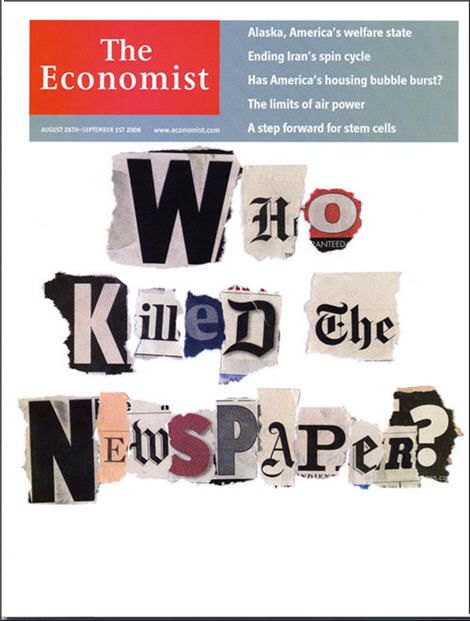
I remember when this August 2004 Economist issue arrived at my family’s home. My brother was visiting from New York where he was at Columbia’s School of Journalism, and he and my father told me to remember the cover image because it represented the future of journalism. For some reason, the ransom note-inspired cover stuck in my memory and I have realized over and over that it speaks a truth still relevant today.

What has changed in journalism and other printed material since 2004?

The development of a new genre of literature. Regardless of one’s opinion about print vs. digital material, the reality is that digital media has become a genre all its own within the literary tradition complete with its own digital archive.

What makes online literature and journalism its own genre is complex, from the immediacy of publication and reception to the physical manifestation it takes on desktops, iPhones, and iPads. One notable characteristic of the genre is the new sense of time and space. Digital literary material is often shorter and is marked by straightforward diction and the use of imagery to invoke something in fewer words. The scale has also shifted within this new genre, with more information available in a shorter amount of time in a larger level of accessibility than print material. In this way, digital literary material facilitates transnational communication and the development of globalized online communities and discourse (see the Arab Spring).

Other aspects of the genre include the use of external links, which function as a type of digital embedded narrative in which there is a story within a story. An article’s external link amplifies the material in the original text, creating a cross-disciplinary frame within a frame. It also facilitates communication between writers and publications, creating an online community and forum.

Finally, the digital literary genre’s most notable quality: the digital soapbox. Online literature is often unmediated and is an available location for multiple voices as once. Our confession culture means that people often find self-authenticity through voice, and the internet is an immediately accessible publication space. Because of this, secret hobbies and quirks are transformed into public art forms and online forums, cultivating subcultures that transcend geographic and social boundaries. The digital soapbox is perhaps the most defining aspect of the digital literary genre that most characterizes the archive and distinguishes it from print material, providing a product unique to online materials.

Sunday, April 22, 2012

Making Room for Spirituality Within Postmodern Literature


We are living in postmodern times.

Within a postmodern theoretical framework, there are no absolute truths because truth is considered a social construct based on historical moments and cultural contexts. According to this logic, everything we know is based on the social context in which we live. Currently, academic disciples from ethnic studies to philosophy to art are influenced by postmodern theory.

In postmodern literary theory, the traditional interpretation maintains an incompatibility between religion and literature based on the theory’s dismantling of universals and absolute truths. Since religion claims to have dogmas and doctrines, it is at odds with postmodernism.

Yet in the academy and in the real world, spirituality remains ever-present. In spite of the rise of secularism, publicity on disagreements with the Catholic Church, and the replacement of Genesis with evolution, theological concerns and mystical experiences continue to be relevant and to have significance for many people.

In the late twentieth century and early twenty-first, theorists observed a reemergence of existential and spiritual questions in American literature, marking a transition that continues today. This return of theological dialogue within literary works disrupts the assumed incompatibility between religion and literature and marks fiction and nonfiction as a location for exploring spiritual themes. The rise of religious discourse in literature suggests that either traditional interpretations of postmodernism have significant shortcomings insofar as they do not account for religious questions or that there is a shift within the theory in which there is a renewed interest in religious themes within postmodernity. In the latter, postmodernism could provide tools for religious questions regarding faith, institution, and truth.

There are many literary texts within this movement that engage in religious and existential dialogues within postmodern frameworks. Some authors who have been credited as postmodernists writing about religious themes include Toni Morrison, Allen Ginsberg, Don DeLillo, and bell hooks, to name a few. These writers are informed by postmodern concepts of race, gender, existentialism, and subjectivity and apply them to religious issues. This movement within the literary tradition to incorporate religious topics and themes in a postmodern era suggests excluding religious dialogue ignores the religious and existential impulse and the influence of religious traditions on culture and history.

Within the creative genre of literature, a postmodern theoretical framework can provide tools that help construct a critique of traditional ideas of God in search of existential meaning beyond human institutions. By utilizing the postmodern idea of decentering universals, literary works can create a new dialogue about religion and religious traditions that participates in a theoretical, literary, and cultural transition in the second half of the twentieth century.

Theorists who have contributed to this conversation include the oft-credited founder of postmodernism, Jacques Derrida (pictured), whose “theological turn” in Acts of Religion explored religious questions regarding truth and the aporia between the empirical and the transcendental. Additionally, Pericles Lewis suggests in Religious Experience and the Modernist Novel that literature began replacing institutional religion in the middle of the twentieth century by reimagining religion and abstracting spiritual truths from tradition. Amy Hungerford argues that in a pluralist and postmodern era, meaninglessness is resolved in literature. She borrows Graham Ward’s phrase “postmodern theology” to suggest that characteristics of the theory can be valuably applied to religion in literature in order to revise dominant religious paradigms. Feminist theologians and third wave feminists who are informed by postmodernism, from Mary McClintock Fulkerson to Luce Irigaray, pioneer the reimagination of traditional patriarchal religion and disrupt assumed religious universals of God the Father and the masculine trinity.

These historical, cultural, and literary conversations leave two questions. First, what is the future of postmodernism given its problematic stance on religion? And second, what is the future of religion, given the persuading postmodern

Wednesday, April 18, 2012

Paradise Lost


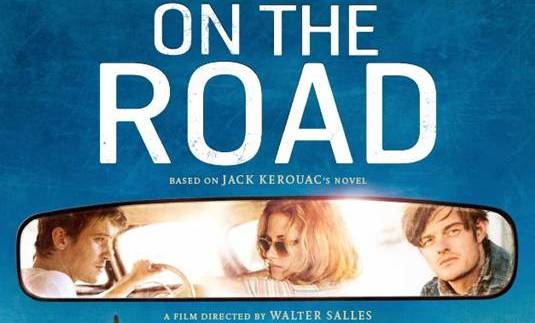
The film adaptation of Jack Kerouac’s generation-defining On The Road is coming out this May, bringing up a lot of themes of American identity, wanderlust, and existential fulfillment (or lack thereof). Yet one thing that is often overlooked in readings of On The Road is its problematic portrayal of manhood and womanhood. In spite of the novel’s nostalgic musings that defined the Beat generation, its portrayal of relationships between men and women is jarringly problematic, hierarchical, and abusive. How can we reconcile the book’s timeless theme of soul-searching with the disturbing relationships between and portrayals of men and women in 2012?

When Kerouac and Neal Cassady made their odyssey across America they were trying to break free from the suburban, pre-Kennedy corporate drone that represented the norm for American men. Their characters, Sal Paradise and Dean Moriarty, are in search of independence, ruggedness, and adventure and often refer to themselves as cowboys. As incarnations of the modern cowboy, the two men feel a sense of Western independence in the midst of the 1950s suburban male prototype. They successfully create a new heroic figure that embodied independence and rugged adventure, a stark contrast to the buttoned up mid-century American man. Yet Kerouac’s version of the cowboy has a flawed sense of masculinity that romanticizes and idolizes individualism and selfishness.

The men’s relationships with the women in their lives became complicated because they often represented the social system the men are fighting against and they are characterized in the novel with domesticity, maternity, and loyalty to relationships and responsibilities (see Marylou, Camille, and Old Bull’s wife, Jane). Thus, the women present a threat to Kerouac’s new man of the West and are repeatedly abandoned and are physically and emotionally abused. Additionally, women’s need for new gender roles in the 1950s is overlooked in the novel, and they are neglected the opportunity for their equivalent of a cowboy ethic.

In an attempt to restore the lost masculinity from the American West in 1950s America, Kerouac’s men tragically become selfish and self-destructive and simultaneously subjugate the women in their lives because of their association with this bourgeois domestic system.

In 2012, how should we read On The Road and its revival in film? There are still problematic social expectations for both genders today, and controversy about sexuality are frequently in the news, but American culture has come a long way since the novel was published. Is it possible to read the more positive themes of self-discovery, liberation from The Man, and adventure in the upcoming film without getting prescribed negative, dated themes of manhood and womanhood in our historical moment? Can we separate the idyllic nostalgia for wanderlust from the reality?