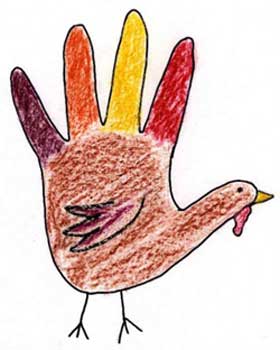
A year ago, a wonderful
professor at the University of Chicago taught some master’s students about
Althusser’s theory of ideology in “Ideology and the State” using the
Thanksgiving hand turkey. In short—to try to write an analytical piece months after
graduate school—Althusser’s ideology is a social, political, and economic structure
in which individuals self-identify in relation to their labor. In other words,
we self-identify through the work we repeatedly do within the social, economic,
and political environment we live in, which ultimately reinforces these systems.
The hand turkey can be understood as a representation of Althusser’s ideology
because Americans recognize the bizarre image of an outlined hand with red and
orange crayon as the representation of a turkey, which in turn represents
Thanksgiving. We can only recognize this image, which looks nothing like a
turkey and could represent many other things beside Thanksgiving, because we
are within a system that taught us to make the hand turkey as children for
Thanksgiving. In making the hand turkey repeatedly every year in grade school
(our labor), we self-identify (those who celebrate Thanksgiving) through our
work within an economic, political, and social structure (America), thus
reinforcing the system (we know that hand turkeys mean Thanksgiving).
1. Absolute Trust in
the Goodness of the Earth by
Alice Walker
Walker’s
poetry responds to post-9/11 emotional trauma with “less yang, far, far more
yin.” Her poems imagine meditative spaces and explore native traditions of the
Americas and Africa for spiritual healing in the West.
2.
Thirst by Mary Oliver
This
anthology of poems, written after the death of Oliver’s life partner, has an
elegiac tone as the poet encounters faith, healing, and restoration. Poems
address grief, belief, and meditation, as exemplified in the poem, “Prayer.”
3.
The Stream and the Sapphire by
Denise Levertov
Levertov’s
collection of poems reclaims Biblical myths and figures from a feminist lens.
Her poetry serves as a spiritual exercise that contemplate grace while inspiring
Ignatian-like social justice.
4.
Aunt Carmen’s Book of Practical Saints by Pat Mora
Mora’s
poetry acts as an extension of the rural New Mexican Catholic tradition of
worshipping local saints. Her poetry-as-prayer is paired with images of
wood-carved saints, aligning multiple art media with spiritual vocation.
5.
The Fifth Sacred Thing by
Starhawk
Starhawk, a prominent pagan feminist who practices
earth-based spirituality, explores ecological crisis, progressive love
relationships, and spiritual odysseys in her famous post-apocalyptic novel.
Sizeism is perhaps one of
the most prevalent, unidentified prejudice for America in 2012. It is not an
academic disciple like ethnic or gender studies nor has clear legal definitions
for discrimination, yet it is widely present in our culture. In a recent poll on weight prejudice conducted by Yale’s Rudd Center for Food Policy and Obesity
director, Rebecca Puhl, Ph.D, and Glamour magazine,
men and women were asked to choose from pairs of words to assign to
photographed women they had never met. The project revealed heavier women were
more likely to be labeled “lazy,” “sloppy,” “giving,” and “undisciplined” than
skinnier women, while thinner women were more likely described as “conceited,”
“superficial,” “bitchy,” “vain,” and “controlling.”
The project reveals how
much body size and shape plays into perceptions of identity, character, and
even friendliness, and raises questions regarding how much people realize they
participate in discrimination based on size. Dr. Ruhl observes, “weight is one
of the last acceptable prejudices.” Yet weight is also one of the last
unidentified sites of prejudice because people often do not recognize sizeism
as discrimination.
Sizeism is complicated
because it plays both social and medical roles. When 35.7% of American adults
are obese, sensitivity about fat shaming can take the back burner to health
concerns regarding Americans’ problems with emotional eating, portion control,
and food deserts.
Yet there is an important distinction between attitudes about food as health
issues and attitudes about body shape as social issues.
Sizeism is slowly
becoming recognized as a form of discrimination and prejudice in the media and
academy. Zooey Deschanel, Sophia Rossi, and Molly McAleer’s website,
HelloGiggles, has featured two articles on sizeism: one on ending fat shaming
and one on ending skinny shaming. Jane Pratt and SAY Media's website, xoJane.com, has featured
multiple articles like this one
that identify fat shaming as intolerance. Ms. Magazine blog has also documented
feminism’s future in body acceptance in articles like this one on fat activism
and this one on the perpetration of negative attitudes about body image.
Substantia Jones of The Adipositivity Project has
created a movement for reformed social attitudes about weight, specifically
“fat physicality,” by portraying images of overweight women. The Adipositivity
Project promotes size acceptance in which “the hope is to widen definitions of
physical beauty. Literally.”
The future of sizeism is
recognizing it as a prejudice, and hopefully in doing so, attitudes about size
will transform social norms of body image, health, and activism.
In the year 2012, the
following movies have or will be released: The Avengers, The Amazing
Spiderman, The Dark Knight Rises, Mirror Mirror, Snow White and the Huntsman,
Dark Shadows, and Breaking
Dawn Pt II. The following TV
shows are on basic cable: Grimm, Once Upon a Time and The Vampire Diaries.
Why are these old fairy
tales, hero plotlines, and fantasies still relevant in 2012?
The repopularization of
these legends and tales is perhaps in part due to a nostalgic search for the
timeless in a rapidly evolving, tech-savvy culture. Yet what is most
interesting about these stories is that people genuinely enjoy them even
centuries after their genesis. There is something relatable about these
familiar characters and figures.
These recurring figures
and images echo what psychiatrist Carl Jung, one of Freud’s students and
contemporaries, identifies as archetypes within the collective unconscious. He
explains:
“In
addition to our immediate consciousness…there exists a second psychic system of
a collective, universal, and impersonal nature which is identical in all
individuals. This collective unconscious does not develop individually but is
inherited. It consists of pre-existent forms, the archetypes, which can only
become conscious secondarily and which give definite form to certain psychic
contents.”[1]
Jung argues the
collective unconscious originates in prehistoric humankind and contains
archetypes—mythic symbols common in all cultures and which hold similar
significance across communities—that present themselves in dreams, mythology,
religious parables, and fairy tales. Common archetypal figures include the
shadow, the anima-animus (feminine and masculine qualities), the mother, the
child, the maiden, and the wise old man.[2]
Modern fantasies in 2012
access these archetypes and the meaning they hold that is relevant today. The
evil queen in Mirror Mirror and
Snow White and the Huntsman invokes
the animus within all women who represents reason, power, and strength. Michael
Caine’s Alfred in The Dark Knight Rises embodies the wise old man who counsels and guides. Dark Shadows’s
Dr. Julia Hoffman represents the
mother archetype who nurtures with love and ambivalence.
Perhaps, then, the
resurrection of fantasy films and shows is not due to the need for escape or
for returning to something lost. Perhaps instead it is because, even in 2012,
there are mythic elements we will always be able to relate to that helps us
better understand our own unconscious and the collective unconscious inherent
across cultures.
[1] C. G. Jung, The Archetypes and the Collective
Unconscious. (London: Bollingen
Series, 1996) 43.
[2] Wilson M. Hudson. “Jung on Myth and the Mythic.”
The Sunny Slopes of Long Ago.
(Denton, Texas: University of North Texas Press, 2000), 186.
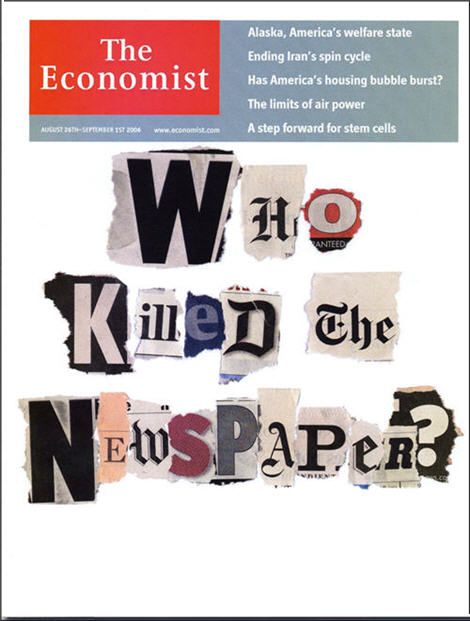
I remember when this
August 2004 Economist issue arrived at my family’s home. My brother was
visiting from New York where he was at Columbia’s School of Journalism, and he
and my father told me to remember the cover image because it represented the
future of journalism. For some reason, the ransom note-inspired cover stuck in
my memory and I have realized over and over that it speaks a truth still
relevant today.
What has changed in
journalism and other printed material since 2004?
The development of a new
genre of literature. Regardless of one’s opinion about print vs. digital
material, the reality is that digital media has become a genre all its own
within the literary tradition complete with its own digital archive.
What makes online
literature and journalism its own genre is complex, from the immediacy of
publication and reception to the physical manifestation it takes on desktops,
iPhones, and iPads. One notable characteristic of the genre is the new sense of
time and space. Digital literary material is often shorter and is marked by
straightforward diction and the use of imagery to invoke something in fewer
words. The scale has also shifted within this new genre, with more information
available in a shorter amount of time in a larger level of accessibility than
print material. In this way, digital literary material facilitates
transnational communication and the development of globalized online
communities and discourse (see the Arab Spring).
Other aspects of the
genre include the use of external links,
which function as a type of digital embedded narrative in which there is a
story within a story. An article’s external link amplifies the material in the
original text, creating a cross-disciplinary frame within a frame. It also
facilitates communication between writers and publications, creating an online
community and forum.
Finally, the digital
literary genre’s most notable quality: the digital soapbox. Online literature
is often unmediated and is an available location for multiple voices as once.
Our confession culture means that people often find self-authenticity through
voice, and the internet is an immediately accessible publication space. Because
of this, secret hobbies and quirks are transformed into public art forms and
online forums, cultivating subcultures that transcend geographic and social
boundaries. The digital soapbox is perhaps the most defining aspect of the
digital literary genre that most characterizes the archive and distinguishes it
from print material, providing a product unique to online materials.
Within a postmodern
theoretical framework, there are no absolute truths because truth is considered
a social construct based on historical moments and cultural contexts. According
to this logic, everything we know is based on the social context in which we
live. Currently, academic disciples from ethnic studies to philosophy to art
are influenced by postmodern theory.
In postmodern literary
theory, the traditional interpretation maintains an incompatibility between
religion and literature based on the theory’s dismantling of universals and
absolute truths. Since religion claims to have dogmas and doctrines, it is at
odds with postmodernism.
Yet in the academy and in
the real world, spirituality remains ever-present. In spite of the rise of
secularism, publicity on disagreements with the Catholic Church, and the
replacement of Genesis with evolution, theological concerns and mystical experiences
continue to be relevant and to have significance for many people.
In the late twentieth
century and early twenty-first, theorists observed a reemergence of existential
and spiritual questions in American literature, marking a transition that continues
today. This return of theological dialogue within literary works disrupts the
assumed incompatibility between religion and literature and marks fiction and
nonfiction as a location for exploring spiritual themes. The rise of religious
discourse in literature suggests that either traditional interpretations of
postmodernism have significant shortcomings insofar as they do not account for
religious questions or that there is a shift within the theory in which there
is a renewed interest in religious themes within postmodernity. In the latter,
postmodernism could provide tools for religious questions regarding faith,
institution, and truth.
There are many literary
texts within this movement that engage in religious and existential dialogues within postmodern frameworks. Some
authors who have been credited as postmodernists writing about religious themes
include Toni Morrison, Allen Ginsberg, Don DeLillo, and bell hooks, to name a
few. These writers are informed by postmodern concepts of race, gender,
existentialism, and subjectivity and apply them to religious issues. This
movement within the literary tradition to incorporate religious topics and
themes in a postmodern era suggests excluding religious dialogue ignores the
religious and existential impulse and the influence of religious traditions on
culture and history.
Within the creative genre
of literature, a postmodern theoretical framework can provide tools that help
construct a critique of traditional ideas of God in search of existential
meaning beyond human institutions. By utilizing the postmodern idea of
decentering universals, literary works can create a new dialogue about religion
and religious traditions that participates in a theoretical, literary, and
cultural transition in the second half of the twentieth century.
Theorists who have
contributed to this conversation include the oft-credited founder of
postmodernism, Jacques Derrida (pictured), whose “theological turn” in Acts of Religion explored religious questions regarding truth and
the aporia between the empirical and the transcendental. Additionally, Pericles
Lewis suggests in Religious Experience and the Modernist Novel that literature began replacing institutional
religion in the middle of the twentieth century by reimagining religion and
abstracting spiritual truths from tradition. Amy Hungerford argues that in a
pluralist and postmodern era, meaninglessness is resolved in literature. She
borrows Graham Ward’s phrase “postmodern theology” to suggest that
characteristics of the theory can be valuably applied to religion in literature
in order to revise dominant religious paradigms. Feminist theologians and third
wave feminists who are informed by postmodernism, from Mary McClintock
Fulkerson to Luce Irigaray, pioneer the reimagination of traditional
patriarchal religion and disrupt assumed religious universals of God the Father
and the masculine trinity.
These historical, cultural, and literary
conversations leave two questions. First, what is the future of postmodernism
given its problematic stance on religion? And second, what is the future of
religion, given the persuading postmodern